In the West Michigan Is Going Places series, we are talking with local business owners and community leaders about their business successes and challenges and highlighting the resources available in the West Michigan business community.
In this interview, we spoke with Steven Huyser-Honig of Grand River Giclée, a Grand Rapids printing business offering fine art printing for artists and photographers and dedicated to helping and supporting artists locally and nationally.
RM: Tell us a little about what your business does and how it got started.
Steven Huyser-Honig: Grand River Giclée works with artists and photographers to create exceptionally accurate and long lasting reproductions of their work. We print on a selection of fine art papers or on canvas and offer matting and framing services as well.
I founded Grand River Giclée as an offshoot from my work as a landscape and nature photographer. I had invested in the equipment and developed the expertise to print my own work and realized I could offer that service to others as well.
How has your business changed since you first started out?
Steven Huyser-Honig: When I launched Grand River Giclée I was working in a small home studio that served both my photography and printing businesses. As both careers developed, I outgrew that space and moved to a 2,000-square-foot studio. A few years later we expanded to our current 4,000-square-foot facility.
Grand River Giclée was launched as a web-based business and met enthusiastic responses from artists all over the United States. Though we now also have a substantial local clientele, that developed more slowly—perhaps because this was influenced more by word-of-mouth referrals than web searches.
Over time it became increasingly difficult to maintain a dual career path, and a couple of years ago I decided to discontinue my work as a photographer to focus all my efforts on helping other artists create beautiful reproductions of their work.
What makes you passionate about what you do?
Steven Huyser-Honig: Inkjet printers that could reproduce photo quality prints were first developed in the mid 1990’s. I will never forget the excitement of watching my first print rolling out of an Epson Stylus Photo printer. As a photographer interested in color it was a truly revolutionary moment. Previously color prints could only practically be made by photo labs—a process that was often disappointing. Now I had complete creative control of the output of my work.
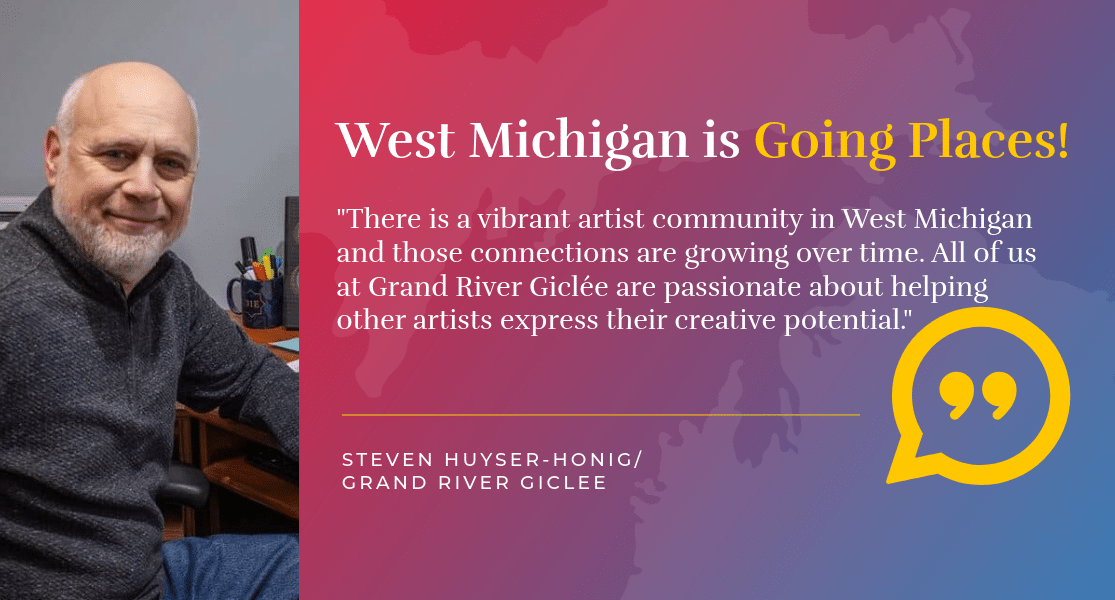
So my initial passion was for a technology that expanded my creative potential. Grand River Giclée has allowed me to collaborate and share that passion with hundreds of artists over the years. All of us at Grand River Giclée are passionate about helping other artists express their creative potential.
How has being here in West Michigan helped your business?
Steven Huyser-Honig: There is a vibrant artist community in West Michigan, and those connections are growing over time. We also find that there is a good supplier base in the area for our needs. Being somewhat centrally located in the US gives us bi-coastal reach, and we have customers from almost every state.
What’s your approach to customer service and connecting with the community?
Steven Huyser-Honig: We work in a somewhat technical field with a customer base that is generally more comfortable with analogue processes. We spend a lot of time educating artists in the processes needed to translate their work into exceptional prints.
Our hope is that our customers will see us as valued collaborators in realizing their creative vision.
How do you plan to grow or adapt your business for the future?
Steven Huyser-Honig: Our business and processes have reached a level of maturity that I don’t anticipate major changes in the near future. Of course we are always looking for ways to improve our processes and customer satisfaction.
Are there any local organizations or networks that have been particularly helpful for you in building your business?
Steven Huyser-Honig: Because our business addresses the needs of a small subculture that is geographically dispersed, we have not found traditional B2B networking to be helpful.